Thursday, February 9, 2012

New SCBA (Self Contained Breathing Apparatus)

The City of Dublin just “upgraded” their fire brigade’s air packs. The old packs were very basic, didn’t have any bells or whistles, and were generally reliable.

Yours truly trying on the new set
 The new SCBAs, or “sets” as the Irish firefighters call them, have an integrated radio system, where the mic and speaker are built into the face piece. The low-pressure regulator clips into the side of the face piece instead of the front, which was new for me. 

See? The regulator is on the side.

The firefighters felt that the new packs were lightweight and cheaply put together. There had already been some problems with low-pressure lines disconnecting from the pack while firefighters were inside structures. I noticed that the air lines were much thinner then the lines on my pack back home, and that I could easily crimp them off with my fingers. It doesn’t seem like it’s good to be able to pinch off your air supply so easily. 

Harness assembly of new pack, shiny.


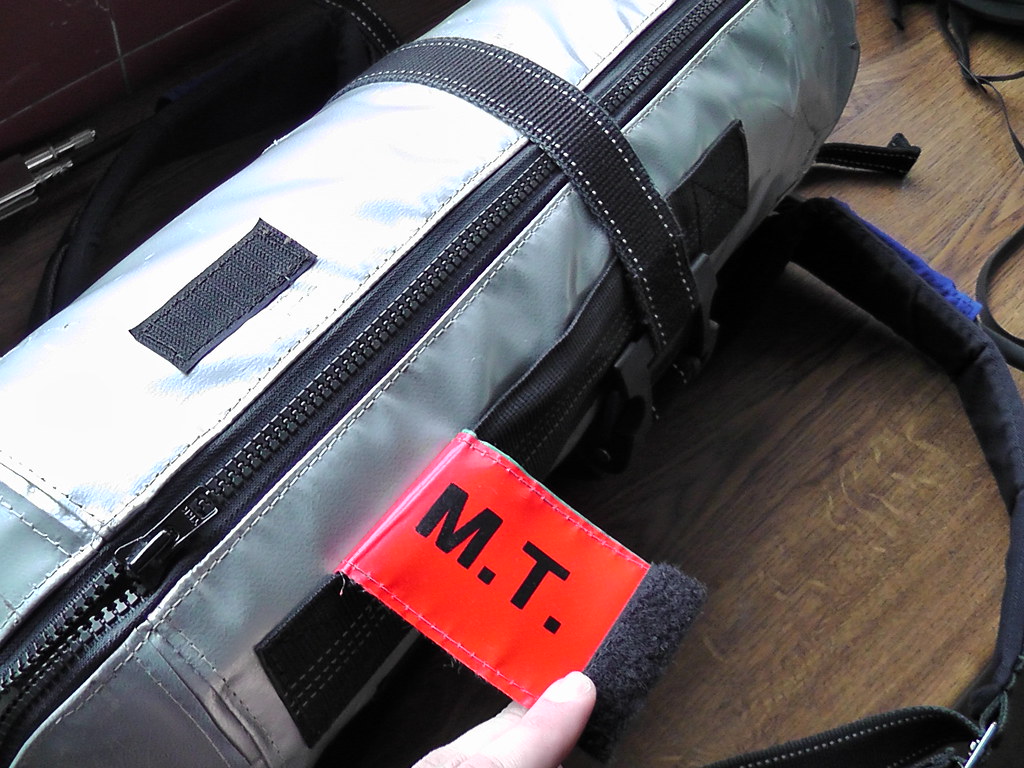
Protective bottle cover
Firefighters sheath their air bottles in protective covers, which can indicate whether the bottler is full or “M.T.” empty. 
M.T. get it? Heh he he.... took me a while actually.
One really cool thing their packs can do is, be adapted to carry two air bottles instead of one. By screwing in the adapter shown below, you can connect two air bottles into what is basically a “T joint”, and BAM! Twice as much air. 
Not the best photo, I admit.


Doing More With Less

Compared to my department, the Dublin Fire Brigade is grossly understaffed. Both Dublin and Madison have 12 stations, and staff their own ambulances with firefighters. Dublin has 120 fire response personnel on per shift, and Madison has 78. Dublin has 12 ambulances and we 8. Madison has a population of roughly 230,000, and Dublin had a staggering population of roughly 1,200,000 people. The difference in our populations is not reflected in our department’s staffing. Dublin is doing more with less.

Now in some respects, the Dublin Fire Brigade is unable to keep up with their call volume. While I was visiting the main station in Dublin, I was told that all 12 ambulances were currently on calls, and that their dispatch center had 21 calls in queue, waiting for an ambulance to become available.

Ambulance in Dublin
 In spite of comparatively low staffing, Dublin does very well when it comes firefighting. A standard fire response is three engine companies. Engine companies in Ireland have crews of 5, and carry many types of equipment in addition to that needed for fire attack. The three engines are usually split into three crews, search, attack, and backup. All three teams have their own hose line. 

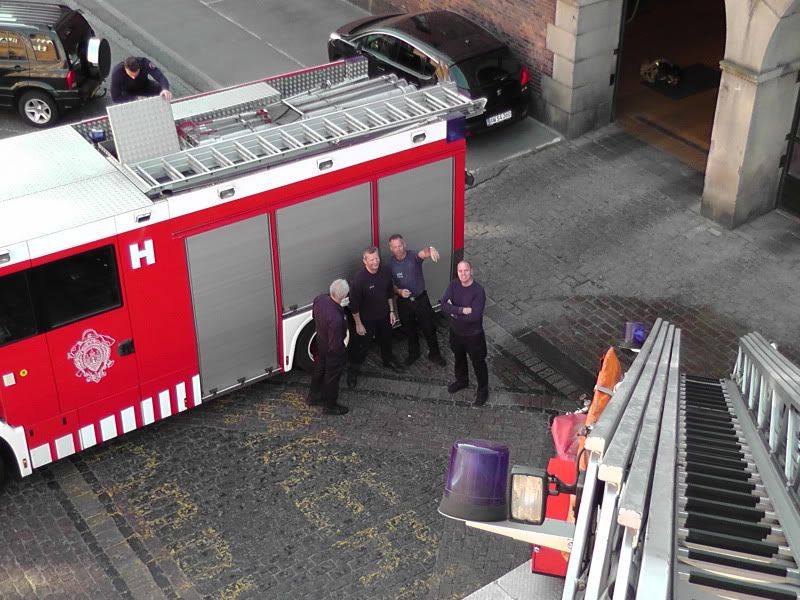
Engine company leaving main station for a call
When fighting a residential fire, the Dublin Fire Brigade usually has the fire knocked down within two minutes of the attack team entering the structure. This is because Dublin has been able to refine, and perfect the way they find and extinguish residential compartment fires. It helps that homes in Ireland are smaller and confine fire well, but the firefighter’s speed of extinguishment reflects quality training and discipline.

Accountability

Firefighters across the world agree, that maintaining accountability (knowing where everyone is) is an essential part of keeping firefighters safe on the fire-ground. Ireland uses some simple technology to accomplish this.

Accountability board on back door of engine.
Every firefighter’s air-pack comes with a tag, which states who’s it is, and how much air they start with. The tag is sheathed in the air-pack’s PASS (Personal Alert Safety System), and when the tag is removed it activates. The PASS monitors the firefighter’s movement so if they become trapped or stop moving, it emits an audible call for help.
PASS device with tag.
Before firefighters enters a building, they slide their tags into the slots on the left hand side of the accountability board. The firefighter running the board, usually the driver, can record entry time and other notes with a dry-erase maker. The dial in the up right corner of the board is a slide-ruler of sorts, used to calculate how long it will that a firefighter to use up their air. 


The beginning of a fire operation is a busy time for the engine driver, who, has to get the pump engaged and water flowing to attack teams. To lighten the driver’s load, the accountability board has rapid entry slots for the first attack teams tags. When a tag is placed into one of these slots, it automatically starts a timer, so once the driver the pump running and gets to the board, they know how long the attack team has been inside.

Tag in an rapid entry slot.

Ventilation/Roof Ladders

In Ireland, many structures have clay tile roofs, this creates a problem when you are trying position a roof ladder. Roof ladders hook over the peak of a roof and help distribute the weight of firefighters working on the roof.
American roof ladder with hooks folded in.

Ordinarily, a firefighter climbs a ground ladder to the edge of the roof, and slides the roof ladder up the roof until the hooks reach the peak. 
Placing roof ladder
But if you attempt to slide a ladder up a clay tile roof it will catch on every tile. So the Irish carry roof ladders with this little innovation.

Hook end of roof ladder sticking out from under storage container.
Hook folded down.


Wheels. The wheels help the ladder roll over the clay tiles.

As near as I can tell, vertical ventilation is not performed in Ireland, as they only ventilate after they have the fire knocked down. So I can’t imagine that their roof ladders get used much, but when they do, a clay tile roof won’t slow them down.

Stop Screwing Around

The fire brigades of Ireland use couplings, which function like a quick-connect on a pneumatic airline. Simply insert the male coupling into the female coupling until it clicks, and you’re done. Unlike threaded and sexless couplings, you do not have to line anything up or screw the couplings together.

Male coupling above, female coupling below.

To release the couplings, pull the two knobs on the female coupling outward and remove the male coupling. 

From this angle the internal latch can be seen, as well as the black rubber gasket which help keep the connection water tight.

I didn’t get to see these couplings in action, but the firefighters I spoke with said they didn’t have problems with them leaking or the release knobs getting caught on things. Lines that have these couplings are primarily used for supplying water to the pumper or defensive fire operations. I did not see them loaded as pre-connected lines.

 Pump panel of Irish fire engine, note the three-into-one intake.
Hydrants in Ireland are below ground, and the quick-connect coupling system is used to attach to them.

By pressing the side levers in, the female coupling can be released from the below ground connection.


The small diameter of their hydrants reflects how much water they use in regular fire operations. In contrast to American fire equipment, everything is oriented towards building a high water pressure, not producing a large volume.

Wednesday, February 8, 2012

Photos from Ireland


 It's hard to write an entry for all of these photos, so instead, here's the link to all of them. I hope you enjoy.

Ireland Album

Sunday, August 14, 2011

Photos from Copenhagen

Because I find myself having trouble creating enough posts for all these photos, here is the link for all of them:

Copenhagen album